

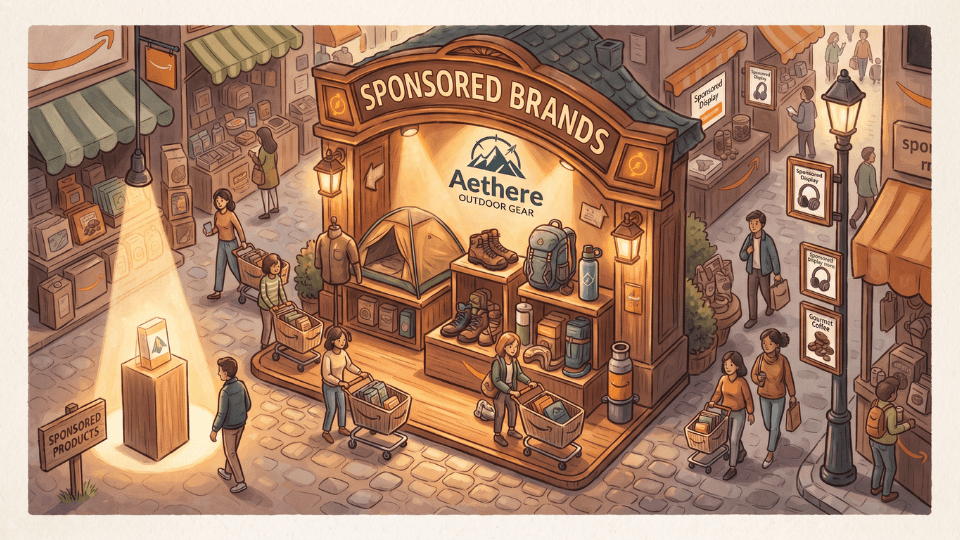
Amazon Sponsored Brands, Getting a shopper to click your Sponsored Brands ad is only the beginning.
The next question may be even more important:
Where are you sending them?
Sponsored Brands can direct shoppers to a product detail page, a custom landing page, or a Brand Store. That flexibility creates an opportunity that sellers sometimes overlook: the destination of your ad should match what you want the shopper to do next.
If your goal is to sell one specific product, a product detail page may make sense.
But if you’re trying to introduce shoppers to your brand or multiple products, sending them to a single ASIN may be leaving part of that opportunity on the table.
Sponsored Brands Are Not Just Bigger Sponsored Products
Sponsored Products are often built around a specific product and a specific shopping opportunity.
Sponsored Brands can serve a different purpose.
Amazon describes Sponsored Brands as a solution designed to support awareness, consideration, customer acquisition, and loyalty. Ads can feature your brand logo, headline, video or lifestyle creative, and multiple products.
That means the objective doesn’t always have to be:
Click → Product → Purchase
It can also be:
Click → Brand → Discover → Consider → Purchase
That difference matters when deciding where your traffic should go.
When a Product Page Makes Sense
Sending Sponsored Brands traffic directly to a product detail page isn’t automatically wrong.
In fact, it can be the right choice when the campaign has a very specific purpose.
For example, you might want to promote:
- A new product
- A seasonal product
- A best seller
- A specific high-priority ASIN
- A product targeting campaign with a clear purchase intent
If the shopper is already searching for something very specific and your ad is built around one product, taking them directly to that product can create a straightforward path to purchase.
The problem comes when sellers use a product-page destination by default, regardless of what the campaign is trying to accomplish.
When a Brand Store Can Make More Sense
Now imagine a shopper searches for a broad category rather than a specific product.
Your Sponsored Brands ad introduces your brand and features several products.
Sending that shopper directly to one ASIN forces them into a very narrow experience.
A Brand Store can give them somewhere else to go.
Amazon describes Brand Stores as dedicated, multipage destinations where brands can showcase their products, organize categories, educate shoppers, and tell their brand story. Sponsored Brands can be used to send shoppers directly to a Brand Store or specific Store pages.
This can be especially useful for brands with:
- Multiple related products
- Several product categories
- Complementary products
- Different product collections
- Products at different price points
Instead of asking the shopper to decide whether one product is right for them, you’re giving them an opportunity to discover what else your brand offers.
Your Landing Page Should Match the Shopper’s Intent
One of the simplest ways to think about Sponsored Brands is to start with the shopper’s intent.
Specific intent
If someone is searching for a very specific product and your ad promotes that exact product, a product detail page may provide the most direct path.
Category-level intent
If someone is searching for a broader category, they may not have decided exactly what they want yet.
This could be an opportunity to introduce them to a collection of relevant products.
Brand-level intent
If the shopper is already searching for your brand or exploring your product line, a Brand Store may give them a better opportunity to discover additional products.
The important point is that one landing page doesn’t have to work for every Sponsored Brands campaign.
Don’t Make the Ad Promise One Thing and the Landing Page Deliver Another
There’s another piece of the equation that is easy to overlook.
The experience after the click should make sense.
Amazon specifically recommends making sure the landing page matches what shoppers expect after clicking the ad.
For example, imagine your Sponsored Brands creative promotes a collection of three related products.
A shopper clicks because they’re interested in the collection.
If they’re suddenly dropped onto one unrelated product page, the journey becomes less intuitive.
The ad created one expectation.
The landing page delivered another.
That disconnect can make the click less valuable.
Your Brand Store Should Have a Purpose
Sending traffic to a Brand Store isn’t automatically better either.
A Brand Store still needs to help the shopper make a decision.
If the shopper lands on a cluttered page with too many products and no clear navigation, you’ve simply moved the problem somewhere else.
Your Store should make it easy to understand:
- What your brand offers
- Which products belong together
- Where the shopper should go next
- Which products are most important
- Why the products are relevant
Amazon recommends structuring Store navigation with purpose and using pages to help shoppers find the products they’re looking for.
Think of the Brand Store as part of the advertising journey, not a storage room for your entire catalog.
Don’t Judge Sponsored Brands Only by the Immediate Sale
This is where Sponsored Brands can require a different perspective.
If the campaign is designed to introduce shoppers to your brand, looking only at immediate sales may not tell the entire story.
Amazon provides new-to-brand metrics that measure orders and sales generated from first-time customers of your brand on Amazon.
Amazon has also introduced a Brand Store page views metric for Sponsored Brands campaigns linked to Brand Stores, allowing advertisers to see how campaigns contribute to engagement within their Store.
These metrics don’t replace sales and efficiency metrics.
They add context.
A campaign designed for brand discovery should be evaluated according to what it was actually designed to accomplish.
The Real Sponsored Brands Question
The question isn’t:
“Should I send my Sponsored Brands traffic to a product page or a Brand Store?“
The better question is:
“What do I want this shopper to do after they click?“
If the answer is:
Buy this specific product, a product page may make sense.
If the answer is:
Discover my product line, a Brand Store may be more appropriate.
If the answer is:
Explore this particular collection, a relevant Store page or custom landing experience may be worth considering.
The destination should support the campaign’s objective.
Final Thought
Sponsored Brands gives sellers something that Sponsored Products doesn’t always provide in the same way: an opportunity to introduce shoppers to the brand behind the product.
That opportunity can be lost when every campaign is treated as a direct-response campaign with the same destination.
Your ad gets the shopper’s attention.
Your landing page determines what happens with that attention.
Before launching your next Sponsored Brands campaign, don’t just ask what you’re advertising. Ask where you’re sending the shopper, what you want them to discover, and what the next step should be.
PPC Center helps Amazon sellers build and optimize advertising strategies around the bigger picture, not just individual campaign metrics. Visit PPCCenter.com and discover how to turn your Sponsored Brands campaigns into a more intentional part of your Amazon growth strategy.